October 10, 2026
Are human remains considered hazmat for international transport?
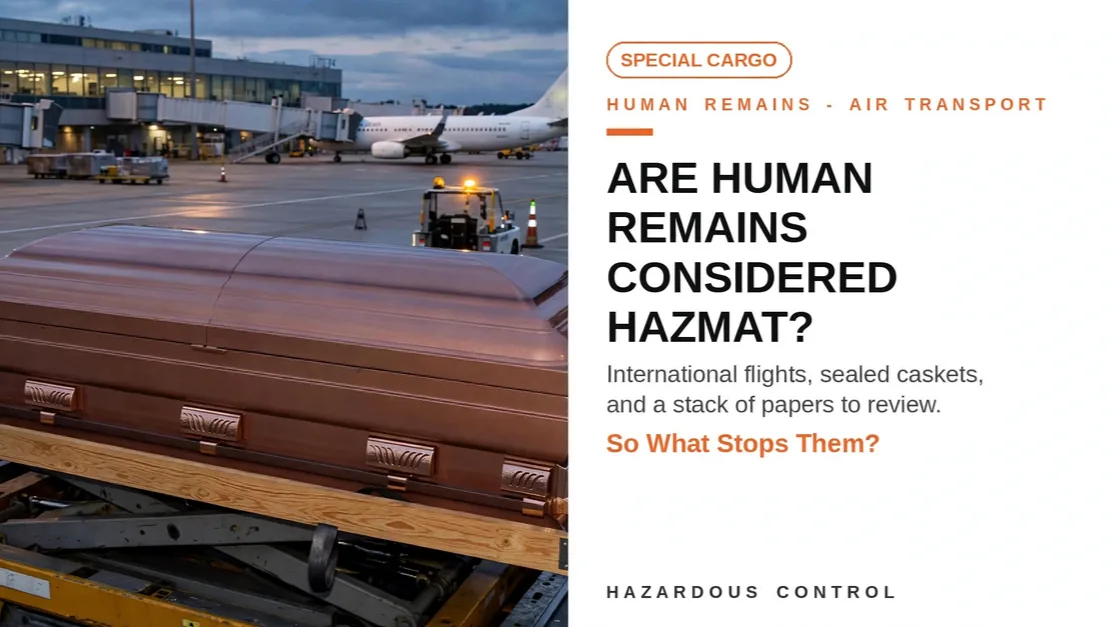
This call usually comes to me when everything is already urgent. A family is waiting in another country, the funeral is set for tomorrow, and the remains are at a cargo counter in Miami with a line of people behind them and a decision to make in minutes.
The agent at the counter looks at the air waybill, looks at the casket on the air tray, and asks the question that decides whether that flight leaves with its most sensitive shipment or without it.
Are human remains hazmat?
It sounds like a question with a stamp and a form behind it. In this industry, anything that is not clearly allowed tends to be treated as regulated until proven otherwise, and a casket at an acceptance counter makes everyone careful. Nobody wants to be the person who accepted the one shipment that should never have flown.
So the documents come out. A certified death certificate. An embalming certificate. Papers reviewed and stamped by a consulate before the airline would even look at the booking. The casket itself, hermetically sealed, in several countries inside a zinc-lined inner container, because the destination will not receive it any other way. The flight booked in advance under a special cargo category, because not every aircraft and not every route takes this shipment.
Paper after paper, seal after seal, approval after approval. It walks like hazmat and it talks like hazmat.
And it is not hazmat.
Human remains are not dangerous goods. Not under the IATA DGR, not under 49 CFR. There is no UN number for a body, no hazard class, no shipper’s declaration. What remains are is special cargo, moved by airlines as HUM, and international movements live or die on paperwork and preparation. The regulation that surrounds them belongs to health authorities, consulates, and airline acceptance rules, not to the dangerous goods list.
Which is exactly why they get stuck. The family is waiting, the funeral is scheduled, and the shipment sits in Miami because a consular stamp is missing, the name on the embalming certificate does not match the air waybill, or the sealing fails the destination country’s rule. Nothing about the cargo is dangerous. Everything about the process can stop it.
There are two corners where dangerous goods really do enter this world. A person who died of a Category A infectious disease changes the picture completely, and many carriers will not accept those remains at all. And on the rare movement preserved with dry ice, the dry ice itself is regulated as UN 1845 and must be marked and declared on the air waybill. In the Miami repatriation trade, where remains travel embalmed, that second case is the exception, not the practice.
Cremated remains travel under the same logic. Ashes are not dangerous goods. They move with death and cremation certificates, in an urn that can pass screening, and they too are delayed more often by a missing document than by anything in the container.
So the next time the question comes up at a counter, with a family waiting on another continent, the answer is short. The work around it is not. Human remains and ashes are not considered Dangerous Goods for international air transport.
The shipment that fails is rarely failed by the cargo itself. It is failed by a document nobody checked before the truck left.
Natalia Pérez
International Hazardous Materials Transportation Instructor and Specialist
Hazardous Control Inc.
By Natalia Pérez, Hazardous Control Inc., Miami. Also published on LinkedIn.